

American History X 1998 Full Movie
On a Television news evidence, the grief-stricken Derek blames his begetter'due south decease on a laundry list of far-right targets. Later we learn it wasn't just his father's death that shaped him, just his father'south dinner table conversation; his begetter tutors him in racism, but the scene feels like tacked-on motivation, and the flick never convincingly charts Derek's path to race hatred.
The scariest and most convincing scenes are the ones in which nosotros see the skinheads bonding. They're led by Derek's brilliant speechmaking and fueled by drugs, beer, tattoos, heavy metal and the need all insecure people feel to belong to a movement greater than themselves. Information technology is assumed in their world (the beaches and playgrounds of the Venice area of L.A.) that all races stick together and are at undeclared war with all others.
Indeed the race hatred of the skinheads is mirrored (with dissimilar words and haircuts) past the other local ethnic groups. Hostile tribalism is an epidemic here.
The film, written by David McKenna and directed by Tony Kaye, uses black and white to show the recent past, and colour to show the 24-hour period afterwards Derek is released from prison. In prison, we learn, Derek underwent a slow transition from a white zealot to a loner--a vicious rape helped speed the process. Meanwhile, immature Danny and his friends (including a massive guy named Seth, played by Ethan Suplee) wreck a grocery run by immigrants. At school, Danny is a good student, as Derek was before him; both are taught by a blackness history instructor named Sweeney (Avery Brooks), who supplies the moral center of the film.
In the immediacy of its moments, in the photography (past Kaye) that makes Venice wait like a grooming ground for the apocalypse, and in the forcefulness of the performances, "American History Ten" is a well-made picture. I kept hoping information technology would be more--that information technology would lift off and fly, every bit it might have with a director similar Oliver Stone, Martin Scorsese or Fasten Lee. But information technology never quite does. Its underlying construction is too apparent, and there are scenes where we sense the motion-picture show hurrying to touch its bases.
One crucially underdeveloped area is Derek'due south prison feel. With a swastika tattooed on his chest, he fits in at get-go with the white power faction, but is disillusioned to find that all the major groups in prison (black, Hispanics, white) accept a working agreement; that'south as well much cooperation for him. Fine, but is it that, or a crucial basketball game, that gets him into trouble? Non clear.
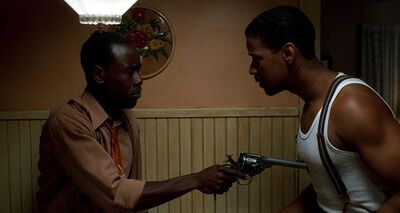
He's assigned to the laundry, where his blackness co-worker (Guy Torry, in a wonderful functioning) gradually--well, begins to seem human to him. Merely there's a strange imbalance in the conversion process. The movie's right-wing ideas are clearly articulated by Derek in forceful rhetoric, but are never answered except in weak liberal mumbles (by a Jewish instructor played by Elliott Gould, among others). And so the blackness laundry worker's large speech is non virtually ideas and feelings, but about sex and how much he misses it. At that place is no effective spokesman for what we might still hopefully describe as American ideals. Well, maybe Derek wouldn't find one in his circles.
What we get, finally, is a series of well-drawn sketches and powerful scenes, in search of an organizing principle. The motion-picture show needs sweep where information technology merely has plot. And Norton, effective equally he is, comes across more than every bit a bright kid with bad ideas than as a racist called-for with detest. (I am reminded of Tim Roth'south truly satanic skinhead in "Made in Uk," a 1982 motion-picture show by Alan Clarke.) Kaye wanted to accept his name removed as the movie'south director, arguing that the film needed more piece of work and that Norton re-edited some sequences. Nosotros will probably never know the truth behind the controversy. My guess is that the post-production repairs were inspired past a screenplay that attempted to cover too much basis in likewise little time and even so hastens to a conventional decision.
Still, I must be clear: This is a expert and powerful moving picture. If I am dissatisfied, it is because it contains the hope of being more information technology is.

Roger Ebert
Roger Ebert was the film critic of the Chicago Sun-Times from 1967 until his death in 2013. In 1975, he won the Pulitzer Prize for distinguished criticism.
Now playing
Film Credits

American History 10 (1998)
118 minutes
Latest blog posts



Comments
Source: https://www.rogerebert.com/reviews/american-history-x-1998
Posted by: jamescancer71.blogspot.com
0 Response to "American History X 1998 Full Movie"
Post a Comment